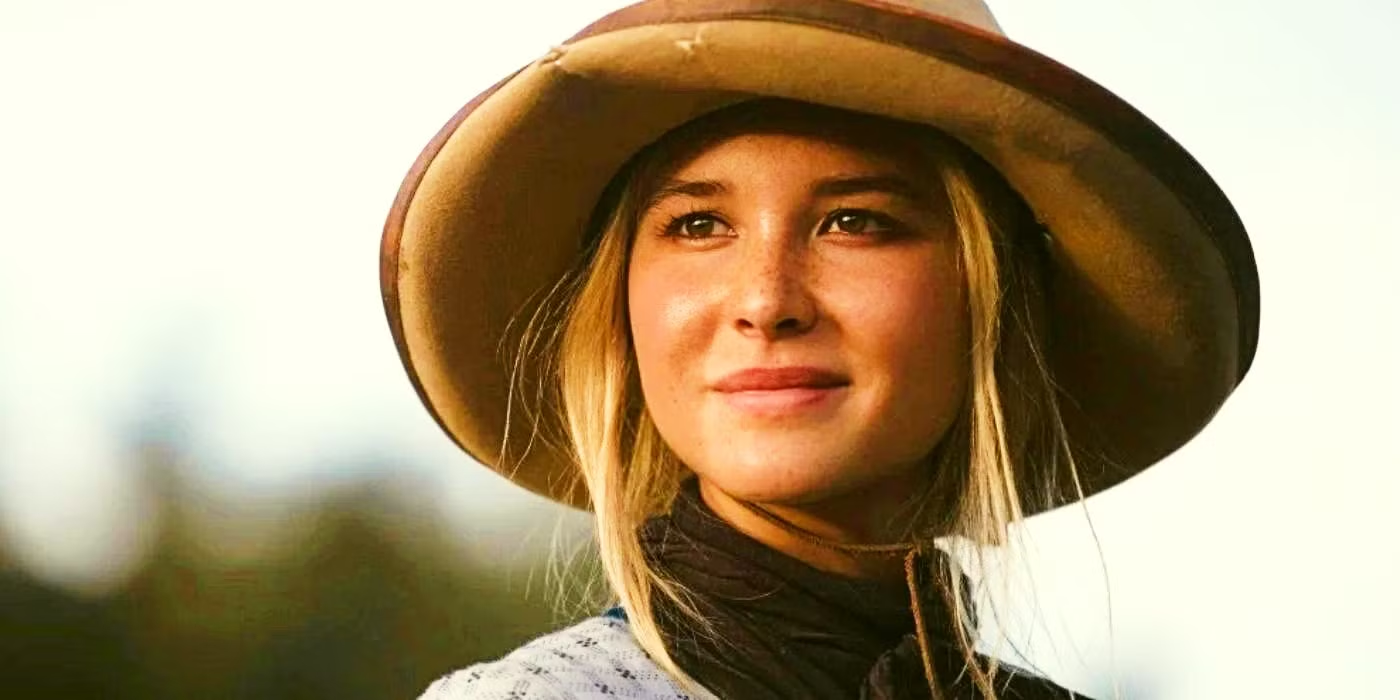
A handful of weathered horsemen, a group of unprepared travelers with almost no frontier survival skills, and one punishing trek north across the American West. Anyone who watched Taylor Sheridan’s Yellowstone prequel 1883 knows that formula well—and for longtime Western fans, it instantly felt familiar for good reason. Decades before the Dutton family set out across the plains, Larry McMurtry’s acclaimed novel and 1989 television miniseries Lonesome Dove blazed the exact same trail.
Far from a passing coincidence, the parallels between 1883 and Lonesome Dove run straight to the heart of why Taylor Sheridan became a storyteller in the first place. From shared geographical routes and brutal trail hazards to unforgettable characters who refuse to bend, Sheridan’s origin story for the Duttons stands as a deeply personal tribute to the classic Western that reshaped his entire career.

How 1883 Mirrors Lonesome Dove’s Brutal Trek From Texas to Montana
Set in the same late-19th-century era, both 1883 and Lonesome Dove follow mismatched groups making the grueling journey from Texas to Montana. In 1883, veteran cowboy James Dutton (Tim McGraw) sets out to build a new life alongside his wife, Margaret (Faith Hill), their spirited daughter Elsa (Isabel May), and young son John (Audie Rick). Guiding the wagon train are two hardened Pinkerton agents, Shea Brennan (Sam Elliott) and Thomas (LaMonica Garrett), joined by a pair of cowhands and a caravan of immigrants entirely unequipped for the harsh realities of the open plains.
That dynamic closely mirrors the 1989 Lonesome Dove miniseries, in which retired Texas Rangers and seasoned cowboys Augustus “Gus” McCrae (Robert Duvall) and Woodrow F. Call (Tommy Lee Jones) drive cattle from Texas to Montana. Their outfit brings together young, illiterate cowhands, immigrant brothers, a saloon woman, and even a dishwasher who plays the accordion.
In both stories, pairing experienced trail bosses with green newcomers exposes the unforgiving reality of frontier survival:
- Relentless Trail Hazards: 1883 refuses to romanticize the West, confronting travelers with a fatal rattlesnake bite, a leg amputation following another snakebite, a deadly cholera outbreak, a Native American massacre, and a harrowing river crossing in which numerous immigrants are run over and drowned.
- Familiar Perils in Lonesome Dove: McMurtry’s classic similarly strips away frontier glamour through snakebites, a grisly death involving water moccasins, and perilous river crossings that echo the chaos seen in 1883.
- Earned Emotional Weight: Rather than using danger merely for shock value, both series anchor their tragedies in universal human themes of grief, perseverance, and the fight simply to stay alive.
How Lonesome Dove Changed Taylor Sheridan’s Life in 1989
For viewers familiar with Sheridan’s background, seeing Lonesome Dove’s DNA woven into 1883 comes as no surprise. Writing the foreword for the 40th-anniversary edition of McMurtry’s novel, Sheridan openly credited Lonesome Dove with altering the course of his life.
“I first read Lonesome Dove in the spring of 1989,” Sheridan wrote. “To say it enthralled me, shocked me, and sparked my imagination before it shattered me is an understatement.”
After watching the television adaptation, Sheridan returned to the book repeatedly—rereading it four, five, or even six times while comparing his own imagination to what appeared on screen. “This is easily the most formative event in my life,” he explained in the foreword. “My plan to pursue the family businesses of law enforcement and cattle raising were destroyed. In its place was an unquenchable thirst for storytelling.”
Sheridan’s admiration didn’t stop on the page. He named his own son Augustus after Duvall’s iconic character, and he recruited former Lonesome Dove production, art, and set designer Cary White to help craft the visual authenticity of Yellowstone, 1883, and 1923. Even Sheridan’s preference for compact, movie-caliber limited runs reflects that influence. Speaking to Deadline about 1883, Sheridan noted, “We wanted to make a ten-hour movie that ended, and that’s what we did”—capturing the same sweeping cinematic scope that made Lonesome Dove a landmark television event. More than 40 years after its debut, Lonesome Dove has enjoyed a notable resurgence—potentially aided by the wave of neo-Western hits Sheridan helped popularize—with Netflix even calling for a new television reboot of the classic.
From Elsa Dutton to Gus McCrae: Shared Archetypes and Bittersweet Endings
Beyond plot mechanics and production design, 1883 and Lonesome Dove share a remarkably similar approach to character. Rather than funneling everything through a single protagonist, both narratives branch across multiple perspectives—much like Yellowstone, 1923, and Landman. While Elsa serves as the emotional center of 1883, James, Margaret, and Shea all carry rich, central arcs, just as Lonesome Dove weaves together the journeys of Gus, Woodrow, Lorena Wood (Diane Lane), and Newt Dobbs (Ricky Schroder).
Both Westerns also spotlight strong-willed women navigating a harsh world. Margaret Dutton anchors her family as a fierce matriarch determined to keep her daughter safe while reminding James of the price their family is paying for his dream. Meanwhile, Elsa’s untamed spirit—which clearly echoes down the family tree to Yellowstone’s Beth Dutton (Kelly Reilly)—shares emotional kinship with Lonesome Dove’s Lorena Wood as both young women experience love and heartbreak on the trail, alongside widowed ranch owner Clara Allen (Anjelica Huston), who boldly rejects marriage proposals on her own terms.
Yet the most striking character parallel links Elsa Dutton directly to Gus McCrae. While James, Shea, and Thomas mirror the stoic, few-words leadership of Woodrow and Gus, Elsa embodies Gus’s larger-than-life, free-spirited hunger to experience everything life has to offer. Both characters deliver memorable, poetic reflections—through Gus’s quotable wit and Elsa’s narration—and both refuse to compromise who they are.
That untamed nature leads both legends toward remarkably similar fates. Elsa is pierced by a Native American spear and slowly succumbs to infection, just as Gus is shot in an attack and faces a gradual, inevitable death. Before passing, each shares a quiet, deeply personal final conversation with a fellow lead and accepts death on their own terms. Both series ultimately close on a poignant blend of survival and loss: Woodrow reaches Montana while Gus dies and Lorena finds peace on Clara’s farm, whereas Shea takes his own life after finally seeing the ocean, Thomas marries Noemi (Graciela Brancusi), and Elsa dies—leaving her Comanche husband, Sam (Martin Sensmeier), waiting unknowingly for her return.
By channeling the spirit of Lonesome Dove into 1883, Sheridan didn’t just honor the story that launched his writing career—he proved that timeless Western journeys, and the unforgettable characters who ride through them, continue to captivate new generations decades later.